Sector
Consumer products
A consumer product must convince at a glance. We ensure that your product looks its best, whether that is in a shop, at a trade fair or in an online environment.
Free consultation
Free consultation

Companies we have successfully helped


The specialist in product visualisations for consumer goods
Your visualisation partner for product launches, retail communication and interactive configurators
In the consumer goods sector, the first impression is decisive. A product that does not stand out in the shop is not bought. A product that is not highly visible online is not considered. And a product that does not immediately make clear at a trade fair what makes it special loses the buyer's attention within seconds.
C4Real makes consumer products visible in the way that suits the moment: a hologram visualisation in-store that grabs attention, a 3D configurator that speeds up the sales process, or a product animation that explains the difference online. We work for manufacturers and brands in the consumer goods sector who want to have a 3D product visualisation, interactive configurator or retail experience created.
Get in touch
Get in touch

Our work
Discover our most successful
projects for consumer goods





Why visualisations are essential in consumer goods
Visualisations make products visible at any time in the customer journey.
In the consumer goods sector, you compete at every touchpoint: in-store, on the website, at a trade fair, in a sales pitch with a retailer. At each of those moments, the same rule applies: if you don't stand out, you won't be chosen.
C4Real creates product visualisations that work at the right moment in the customer journey. For Asics, we developed an interactive hologram visualisation via the Hypebox, presenting the shoe in-store in a completely new way. The transparent display allows interaction with the physical product, while animation demonstrates what makes the technology behind the shoe so special. For Zodiac Aerospace, we built a 3D configurator that allows the sales department to provide immediate visual feedback on customer requirements and send the configuration to production with a single click. This saved the company several weeks per order.
The result: more attention on the shop floor, a shorter sales cycle, and a product presentation that works without requiring a staff member to be present.
Get in touch
Get in touch
Success stories
What our customers say about us


Our Services
With the use of visual technologies that make the difference
At C4Real, we use 3D product visualisations, interactive configurators, retail experiences and product animations to make consumer products visible and convincing at every stage of the customer journey. A 3D product visualisation shows your product from every angle, in every design, even before it is physically available. An interactive configurator gives customers and retailers instant insight into options and delivery times. A retail experience via a transparent screen or an interactive display attracts attention on the shop floor and increases product engagement. We always think about the communication goal first before choosing a format.






Frequently asked questions
Answers to the most frequently asked
questions about consumer products
What are the benefits of visual communication for manufacturers and brands in the consumer goods sector?
Manufacturers and brands in the consumer goods sector that use visualisations see three concrete benefits. More attention on the shop floor: a static display no longer stands out in a crowded retail environment. An interactive hologram visualisation or retail display attracts attention and increases consumer product engagement, as Asics demonstrated with the Hypebox in a retail environment where other displays remained passive. Shorter sales cycle with buyers and retailers: a 3D configurator shows customers immediately what they are ordering and what it delivers, without manual quotation rounds. Zodiac Aerospace reduced the lead time for trolley orders by several weeks. Faster go-to-market: a product visualisation makes it possible to introduce a new product to buyers, retailers, and consumers even before the first production run has taken place.
How do you differentiate a consumer product in a crowded retail environment?
Most retail displays are passive: a product sits still on a shelf or stand, without context, without a story and without interaction. A consumer who doesn't already know what they are looking for will simply walk past. Together with Blast, C4Real developed a hologram visualisation for Asics using the Hypebox: a transparent touchscreen that displays interactive digital content overlaid on the physical product. The shoe takes centre stage in the store while animations on the screen explain the technology and benefits. The difference from a regular display: the consumer actively interacts with the product and understands at a glance what makes it special. This increases awareness and gives the brand the opportunity to test in-store which content, video or interaction, works better.
How do you launch a new consumer product before it is physically available?
Traditional product launches wait for the first physical products. This means that the sales process, press coverage, and retail placement only start once production is already underway. A product visualisation reverses this order. C4Real creates 3D visualisations based on design drawings or CAD files, allowing a product to be photographed, presented, and configured before it even rolls off the line. At the R+T trade fair in Stuttgart, Coulisse launched a new roller blind system featuring a 3D product explorer on tablets. Resellers were able to assess all configurations immediately and decide whether it fit into their range, without waiting for physical products. This significantly shortened the time to market and gave Coulisse direct insight into which configurations were most popular through analytics.
How does visual communication speed up the sales process with buyers and retailers?
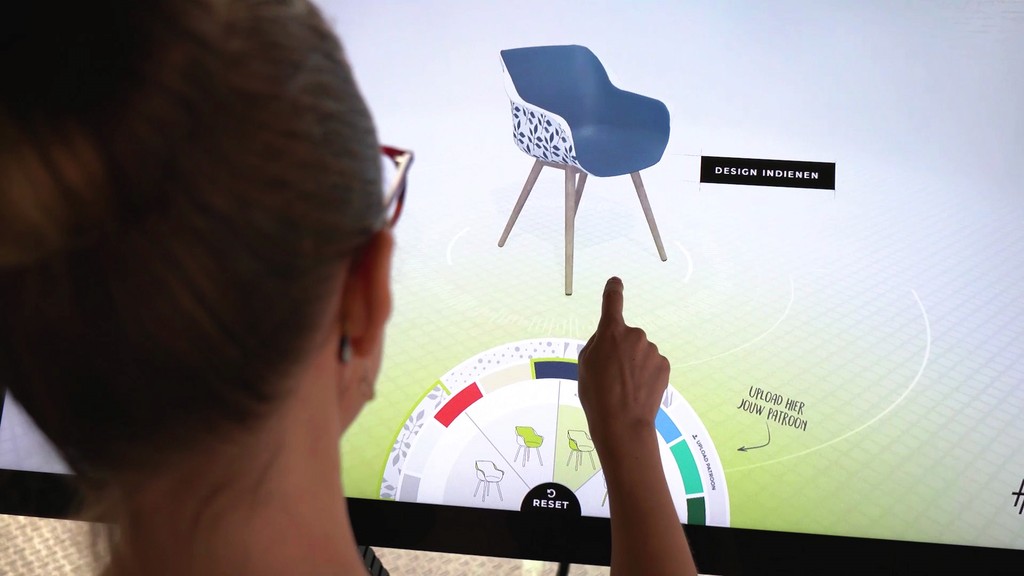
In the consumer goods sector, buyers and retailers make decisions based on expected sales potential, brand value, and assortment fit. A salesperson who tells that story using only words and a catalogue loses valuable time on explanations that fail to convince without visuals. Zodiac Aerospace solved this with a 3D trolley configurator: the sales department provides instant visual feedback on customer requirements, the customer sees exactly what they are ordering, and the configuration is sent to the production department with a single click. This resulted in a lead time reduction of several weeks per order. Hartman introduced the Sophie chair with an online 3D product configurator that allowed consumers and journalists to create their own designs. Within five days, 500 entries were received, even before the product was physically available.
How does a visualisation project at C4Real work?
C4Real works in two phases. In the first phase, concept and design, we translate the communication issue into a visual approach. We determine which format works best, which message is central, and how the target group can best be reached. At the end of this phase, C4Real delivers a concrete concept for the client to feedback on. Only then does the second phase begin: production. This approach keeps the scope clear, prevents surprises afterwards, and gives the client a say at a stage when adjustments are still easy to make.
What does a visualisation project for a consumer product cost?
The costs depend on the complexity of the product, the desired level of detail, and the application. A product visualisation for a press launch requires a different investment than a fully interactive configurator for an international trade fair launch or a retail display experience for multiple stores. C4Real works with a menu of solution levels, ensuring there is always an approach that fits the budget and the communication goal. Please contact us for an informal discussion.